



The Stone Pavilion: A Cotswolds Story by Rigby & Rigby
In the undulating heart of the Cotswolds, where honey-coloured villages sit gently among rolling meadows, a new architectural form began to take shape—quietly, deliberately, with the precision of a jeweller cutting a rare stone.
Rigby & Rigby had long been admired for their ability to craft buildings that felt inevitable, as though they had always belonged to the land they occupied. When a private client approached the studio with a brief for a modular pavilion, something elegant yet functionally flexible, the team saw an opportunity to merge innovation with the region’s storied materiality.
A Vision Set in Stone
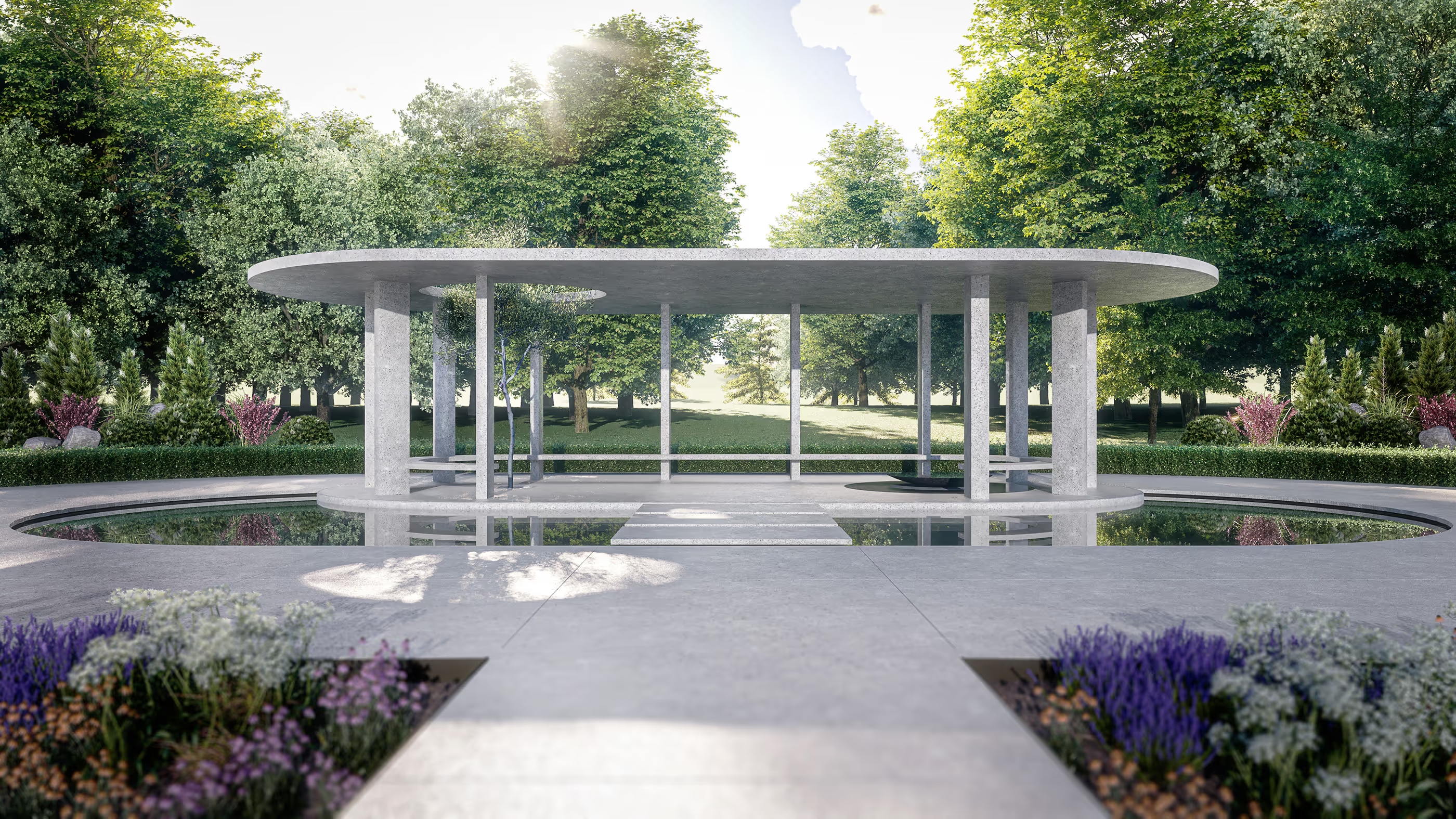
The pavilion was to sit on the edge of an orchard, overlooking miles of velvety hills. It needed to be contemporary, but not intrusive; sculptural, but not loud. The answer revealed itself in a material that had defined the Cotswolds for centuries: stone.
Rather than traditional masonry, Rigby & Rigby chose to employ pre-cast stone modules, meticulously engineered to echo the warm, mineral richness of local limestone. Each panel was designed as both structure and ornament—smooth planes intersecting with softly textured surfaces, catching the shifting light of the English countryside.
But modularity was the true triumph. Panels could be arranged, extended, or reconfigured, allowing the pavilion to evolve with its landscape and its owner’s needs, while still retaining a cohesive architectural language.
Crafted with Precision, Installed with Grace
On site, the process was almost balletic. Pre-cast pieces arrived in a sequence choreographed months in advance. Cranes lifted them into place with a stillness that belied their weight. The pavilion rose not with the dusty chaos of masonry work, but with the clean efficiency of modern craft—quiet, controlled, elegant.
Within days, a structure emerged: a series of interlocking stone volumes with frameless glazing and deep reveals that created pockets of shadow. Inside, floors of polished limestone contrasted with soft timber joinery, offering a sanctuary that was both modern and rooted in place.
A Dialogue with the Landscape
From a distance, the pavilion looked almost carved from the hillside—a contemporary monolith shaped by centuries of sunlight. Yet its modularity allowed openings to frame views with cinematic intent: a cluster of ash trees, the distant ridge line, the shifting clouds rolling in from the west.
In spring, the structure glowed gold. In winter, it held itself like an artefact—stoic, calm, elemental.
Architecture as a Living Object
The client used the pavilion variously: as a studio, a meditation space, a place to entertain guests on warm evenings. Each function was anticipated in Rigby & Rigby’s planning, with systems concealed in walls and discreet services ready for future adaptation. The modular nature ensured that, should the pavilion one day need to grow—a new wing, a gallery, a guest suite—it could do so seamlessly.
This was architecture designed not just for the present, but for a lifetime.
A New Cotswolds Typology
By blending heritage stone aesthetics with cutting-edge modular construction, Rigby & Rigby had quietly introduced a new typology to the Cotswolds: one where tradition is honoured not through imitation, but through intelligent reinterpretation.
The pre-cast stone pavilion stood as proof that modernity could belong in the countryside—so long as it was shaped with sensitivity, mastery, and an unwavering respect for the land.