







Real-Time Engines in 3D Visualisations
What is Real-Time Rendering?
At Rigby & Rigby, architectural visualisation has long been a core part of our in-house practice. It plays an essential role in developing, testing, and communicating design ideas, supporting both internal processes and client engagement. Traditionally, visualisation has relied on offline rendering workflows, where detailed models and authored lighting are rendered over longer periods to produce a number of highly controlled images.
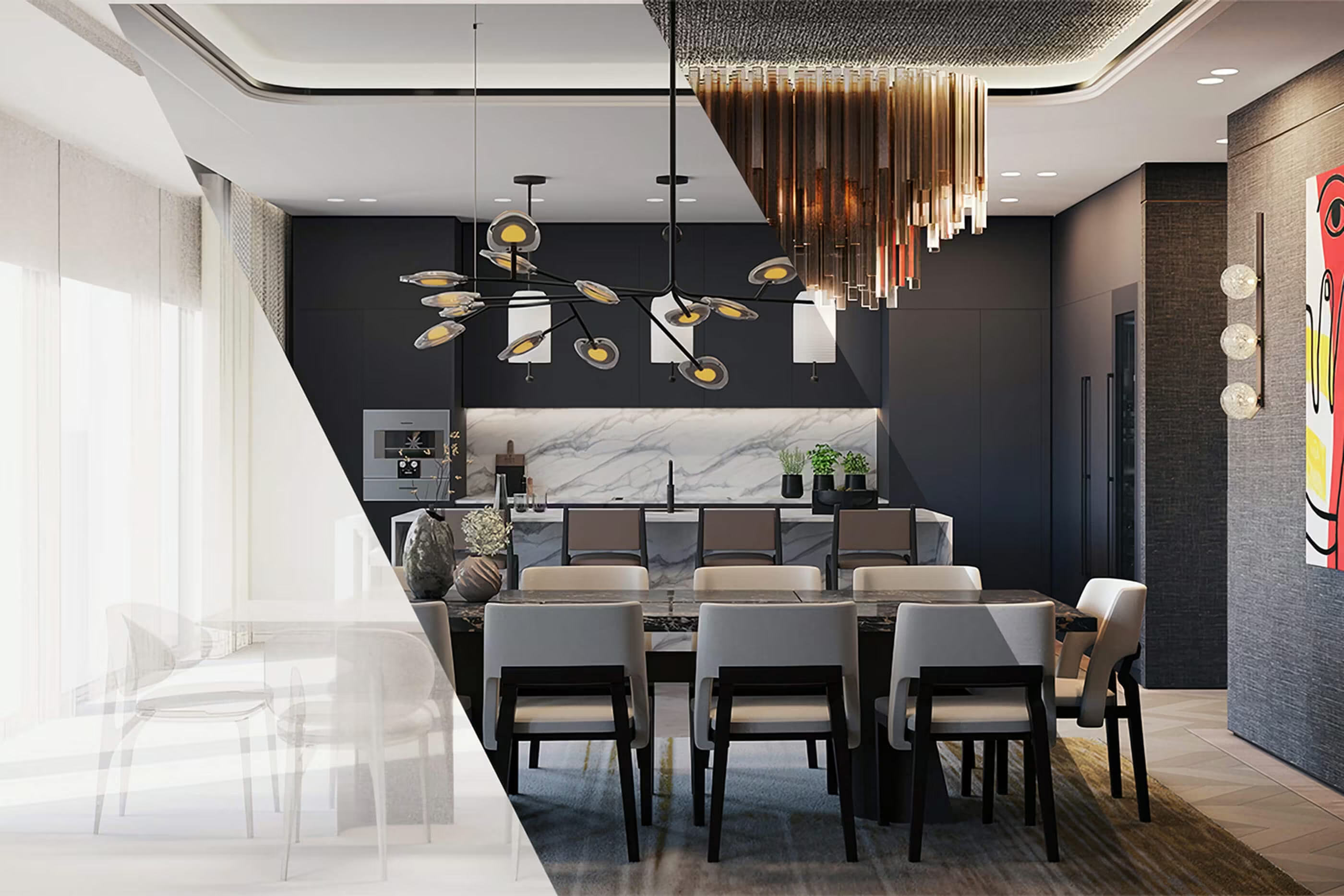
In recent years, real-time rendering engines, originally developed for the video game industry, have begun to find their place within CGI workflows. As real-time rendering generates images interactively, instead of calculating a single image over minutes or hours, these softwares continuously update lighting, materials, and geometry as the viewer moves through a scene. Modern GPUs and optimised pipelines allow engines to rely on approximations, physically based materials (PBR), and hybrid techniques rather than calculating every light bounce physically. The result is an environment that responds immediately to input: lighting can be adjusted, materials swapped, and viewpoints explored without interrupting the visual output.
Tools such as Unreal Engine, Unity, and Twin motion are now part of our discussions, offering more interactive ways to visualise design. Their growing presence raises an important question for our practice: what role do these tools play in architectural visualisation, and what are their advantages and limitations?
Real-Time Engines in Architecture
Real-time technology has matured rapidly within the gaming industry, where responsiveness and immersion are essential. As hardware became more powerful and accessible, these tools began to appeal to architects and visualisation specialists facing familiar constraints: long render times, slow iteration cycles, and increasing demands for clarity from clients.
In architectural contexts, real-time engines are primarily used for:
- Interactive walkthroughs
- Early-stage design exploration
- Client presentations
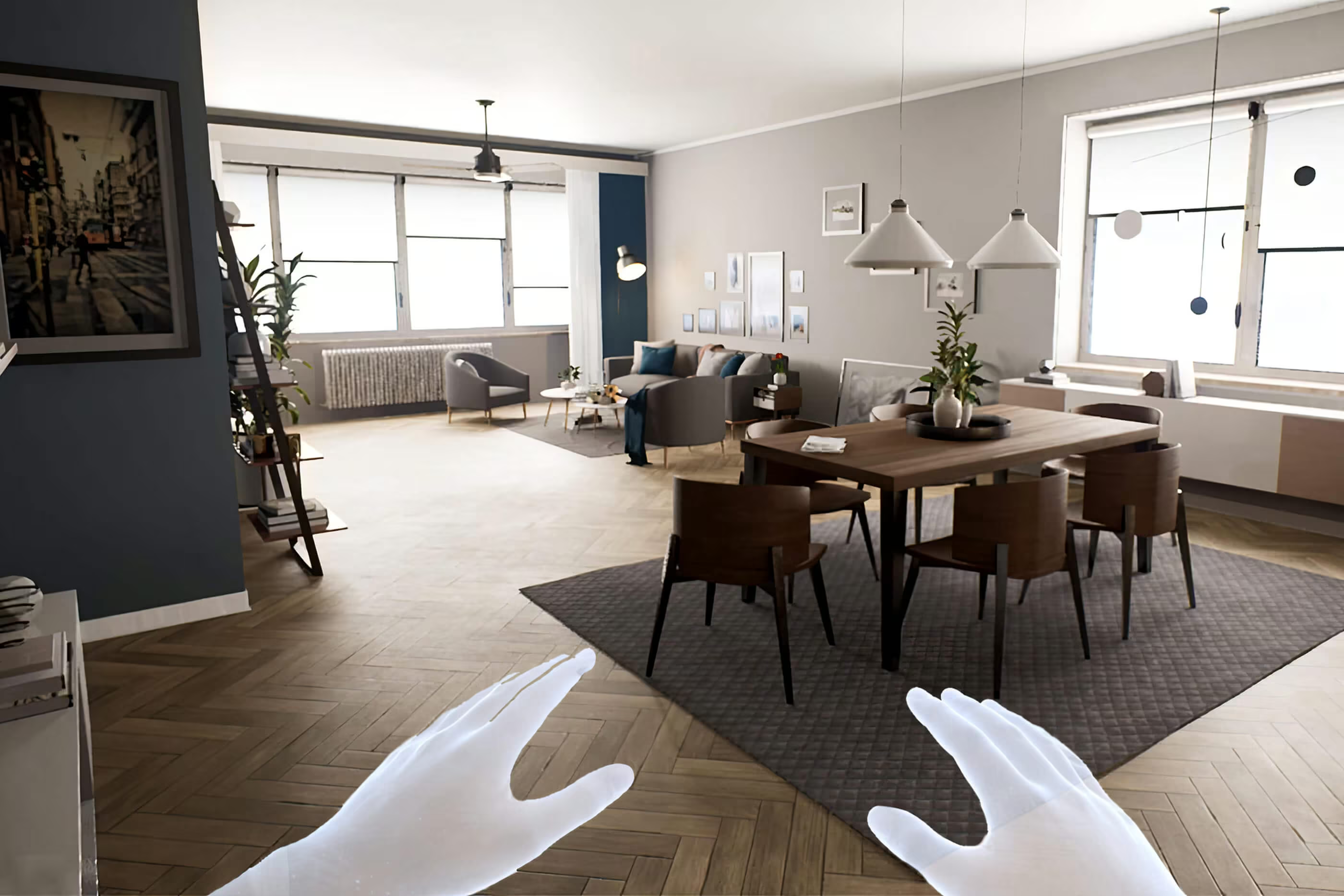
- Virtual reality (VR) experiences
- Large-scale context visualisation
For our 3D studio, this shift is particularly exciting. It gives our designers the ability to move through a space, adjust elements instantly, and understand the space and its volumes more intuitively than through static images alone. As a studio dedicated to exceptional client experiences, we are keen to investigate VR and real-time visualisation. From day-to-night lighting simulations to interactive walkthroughs, these tools could accelerate design exploration while allowing us to stay at the forefront of innovation without compromising quality.
Benefits and limitations
Several developments make real-time engines appealing:
- Dynamic Global Illumination – Lumen allows indirect lighting to respond to changes, accelerating iteration.
- Immersive VR Experiences – Clients can navigate spaces directly, improving engagement and conveying proportions more intuitively.
- Large-Scale Contextual Visualisation – Complex environments can be explored without extensive optimisation, supported by technologies like Nanite.
- Real-Time Animation and Sequencing – Cameras, lighting, and objects can be animated interactively, enabling movement through a space, narrative sequences, and animated outputs without long render times.
Despite their capabilities, real-time engines have constraints:
- Consistency and Predictability – PBR ensures finishes behave reliably under different lighting.
- Visual vs. Physical Accuracy – Effects such as complex caustics, translucency, or precise glass are better suited to offline rendering.
- Technical Setup – Preparing assets, optimising scenes, and managing pipelines can be more complex than traditional methods.
- Project Appropriateness – For some projects, a few carefully composed images remain the most effective solution.
.avif)
Looking Forward at Rigby & Rigby
In practice, many studios adopt a hybrid approach. Real-time engines are used for early design exploration, client engagement, and immersive experiences, while offline rendering remains the preferred method for final marketing imagery or highly controlled visuals. This coexistence reflects a broader shift in architectural visualisation: from static representation toward experiential understanding, without abandoning the precision and craft of traditional techniques.
While our current workflow remains focused on high-quality offline rendering, we are increasingly interested in exploring the potential of real-time visualisation within our studio. Its interactivity, immersive presentation, and ability to communicate spatial ideas in a more immediate way represent a meaningful evolution in how architecture can be experienced and understood.
By recognising the strengths and limitations of real-time visualisation, both we and our clients can use it appropriately and purposefully. Although these tools introduce technical considerations and do not fully replace the accuracy and refinement of traditional offline rendering, we look forward to integrating them thoughtfully into our practice as our workflows continue to evolve.





.jpg)

.jpg)


